Why Boat Lift Problems Deserve Immediate Attention
A malfunctioning lift can strand your boat in the water or hold it at an awkward angle that stresses the hull — and that’s when a timely boat lift repair becomes more than a convenience. In Jacksonville, where boaters use the St. Johns River, the Intracoastal Waterway, and coastal docks year-round, a lift that fails mid-season can sideline a vessel for days if the problem isn’t diagnosed quickly. Catching warning signs early and understanding what drives lift failures puts you ahead of the problem.
Common Signs Your Boat Lift Needs Service
Lifts rarely fail without warning. Watch for these indicators that something is wrong:
- **Uneven lifting or tilting** — If one side of the cradle rises faster than the other, the cables, pulleys, or motor on one side may be worn or misaligned.
- **Grinding or squealing sounds** — Metal-on-metal noise during operation usually points to dry or corroded bearings, worn sheaves, or cable fraying.
- **Slow or jerky movement** — A motor struggling under normal load may have a capacitor issue, low voltage at the dock pedestal, or internal winding damage.
- **Visible cable wear** — Frayed strands, kinks, or rust streaking on the cables are a safety hazard and should be addressed before the next lift cycle.
- **Cradle bunks sitting in water** — If the lift doesn’t raise the boat fully clear of the waterline, the motor, gearbox, or cable drum may not be developing full torque.
Any one of these symptoms warrants a closer look before you trust the lift with your boat.
The Most Frequent Causes of Lift Failure in Florida
Jacksonville’s saltwater and brackish environment accelerates corrosion on every metal component a lift has. Cable strands corrode from the inside out, so a cable can look passable on the surface while its core is compromised. Aluminum and galvanized hardware fare better than bare steel, but neither is immune to the combination of salt air, humidity, and regular submersion.
Electrical issues are the second major category. Shore power at older docks sometimes delivers inconsistent voltage, which shortens motor life. Moisture intrusion into the motor housing or control box causes shorts, tripped breakers, and eventually burned windings. A marine electrician can test voltage at the pedestal and at the motor terminals to isolate where losses are occurring.
Mechanical wear rounds out the list. Pulleys and sheaves develop flat spots or cracked flanges over time. Gearbox seals fail and allow water into the lubricant. Cradle bunks and cross-arms loosen at their mounting points. None of these failures happen overnight, but they compound quickly once they start.
Mobile Repair vs. Hauling to a Shop
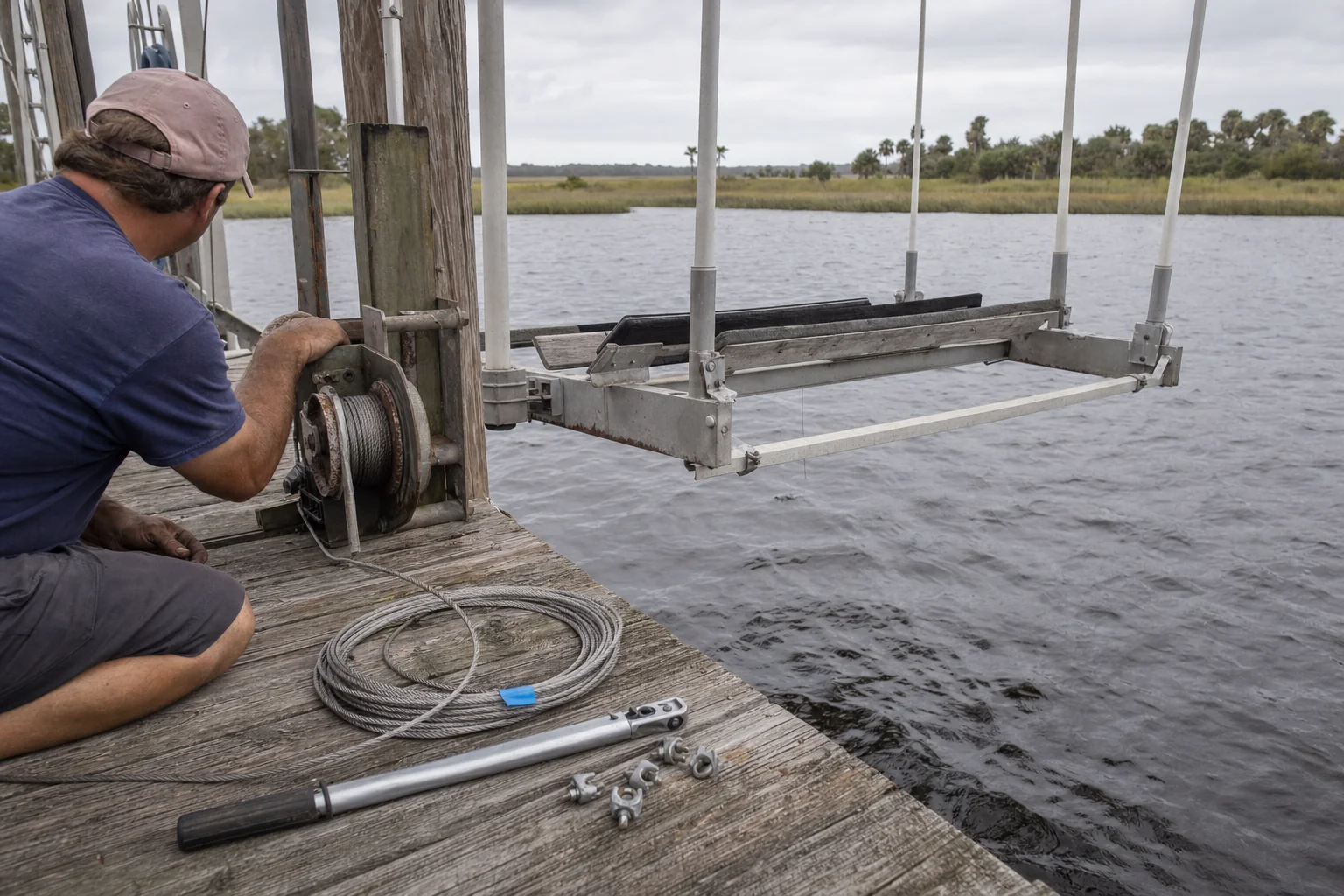
Boat lift components are heavy, dock-mounted, and often partially submerged — conditions that make a fixed shop impractical for most repairs. A mobile marine mechanic can come directly to your dock or marina slip with the tools needed to inspect cables, test the motor electrically, replace sheaves, and repack bearings on-site.
For Jacksonville boaters, this matters because many private docks and marina slips are spread across a large geographic area — from Orange Park and Mandarin on the river to Atlantic Beach and Mayport on the coast. Scheduling a mobile visit eliminates the logistics of disconnecting and transporting heavy lift hardware and gets the repair done where the equipment actually lives.
Mobile mechanics can also assess whether a component truly needs replacement or whether cleaning, lubrication, and adjustment will restore function — a distinction that can save meaningful money on a service call.
What a Thorough Boat Lift Inspection Covers
When a qualified technician evaluates a lift, the inspection should go beyond the obvious symptom. A complete check typically includes:
- **Cable condition and termination points** — looking for fraying, corrosion, and proper swage or clamp attachment
- **Sheave and pulley rotation** — confirming free spin without wobble or flat spots
- **Motor amperage draw** — comparing measured draw against the motor’s nameplate rating to identify overload conditions
- **Control box and wiring** — checking for moisture, loose terminals, and correct breaker sizing
- **Structural hardware** — inspecting mounting bolts, cross-arms, and cradle bunks for corrosion or looseness
- **Gearbox oil level and condition** — milky or dark oil signals water intrusion or overdue service
Documenting findings lets you prioritize repairs by safety risk and budget, rather than guessing at what needs attention first.
Keeping Your Lift Reliable Between Service Calls
A few habits extend lift life considerably. Rinse the motor housing and exposed hardware with fresh water after every use in salt or brackish environments. Apply a marine-grade corrosion inhibitor to cable terminations and sheave axles at least twice a year. Test the lift under load at the start of each season before you depend on it for daily use. And if the lift sits unused for months, run it through a full cycle periodically to keep moving parts from seizing.
For Jacksonville boaters who rely on their lift every week, staying ahead of corrosion and mechanical wear is far less expensive than an emergency repair — or worse, a dropped boat.