The Hidden Complexity of Marine Electrical Systems
Boaters in Jacksonville often overlook electrical service until something stops working at the worst possible moment — mid-channel on the St. Johns River, anchored off the Intracoastal, or docked at a marina with a full day of fishing planned. Marine electrical systems are far more demanding than automotive ones. They operate in a saltwater-saturated environment, endure constant vibration from engines and hull movement, and must power everything from bilge pumps and navigation lights to fishfinders, VHF radios, and trolling motors simultaneously. When one component fails, the effects can cascade quickly.
Common Marine Electrical Problems Jacksonville Boaters Face
Salt air and humidity are the primary enemies of wiring connections on Florida waterways. Corrosion builds up inside terminal connectors, on battery posts, and along wire runs hidden behind panels — often invisibly until a circuit fails completely. Some of the most frequent issues a mobile marine mechanic encounters include:
- **Dead or weak batteries** that won’t hold a charge, often caused by a failing alternator or a parasitic draw from a faulty bilge pump switch
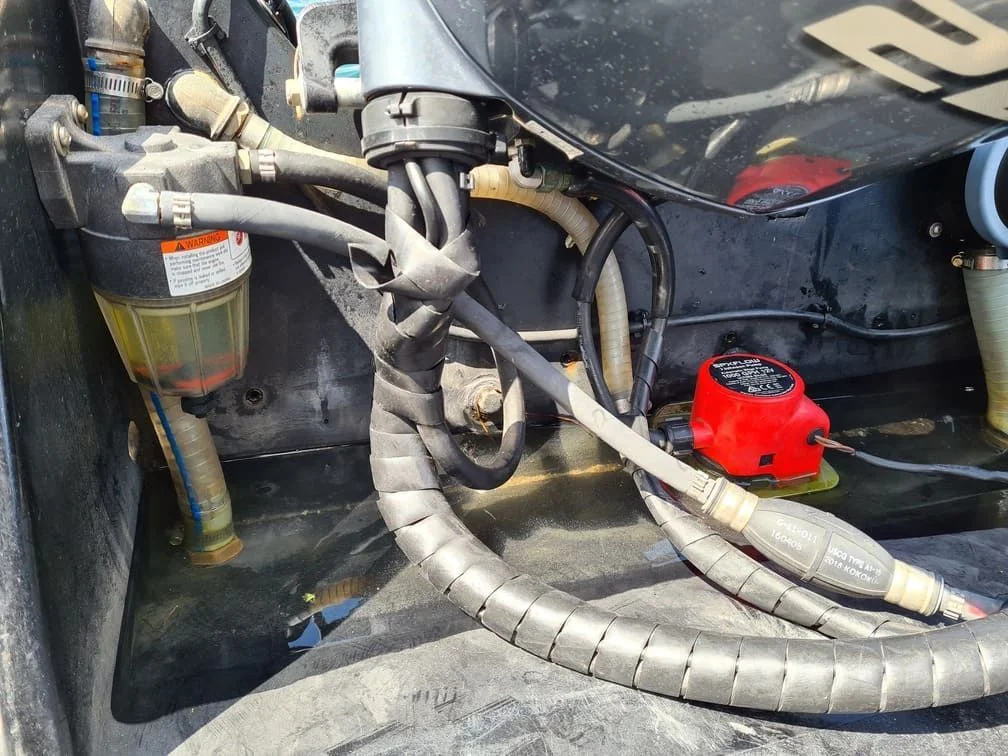
- **Corroded wiring harnesses** near the bilge, transom, or any area exposed to standing water
- **Blown fuses and tripped breakers** that keep recurring, signaling a deeper short circuit
- **Navigation light failures** that create a safety and legal compliance issue on evening or overnight runs
- **Faulty bilge pump circuits**, which are arguably the most dangerous electrical failure on any vessel
- **Instrument cluster and chartplotter issues** tied to loose grounds or damaged NMEA cables
Many of these problems share a root cause: improper original wiring, DIY repairs that didn’t use marine-grade materials, or deferred maintenance that allowed corrosion to spread.
Why Marine Electrical Diagnosis Requires Specialized Knowledge
Diagnosing a boat’s electrical system isn’t the same as troubleshooting a car. Marine wiring standards — largely governed by ABYC guidelines — specify wire gauge, insulation type, connector style, and fusing requirements that differ significantly from automotive norms. A technician unfamiliar with these standards may fix a symptom while missing the underlying code violation that caused it.
Proper diagnosis involves a multimeter, a wiring diagram specific to the vessel’s manufacturer, and a methodical approach to tracing circuits from the battery bank through the distribution panel to each load. On older boats common around Jacksonville — center consoles, bay boats, pontoons — wiring diagrams may not exist, requiring the technician to trace circuits by hand. This is time-consuming work that rewards experience.
A mobile marine mechanic can perform this diagnosis at your slip or mooring, eliminating the cost and hassle of hauling the boat to a shop. For a vessel that won’t start or has lost critical systems, that on-location capability is often the only practical option.
What a Mobile Electrical Repair Visit Actually Covers
When a mobile technician arrives for an electrical service call, the process typically follows a structured sequence. First, the battery bank is tested under load — not just with a simple voltage reading, but with a load tester that reveals true reserve capacity. Next, the charging system is checked: alternator output, voltage regulator function, and shore power connections if the boat is docked.
From there, the technician works through the distribution panel, checking for proper fusing, signs of heat damage, and any circuits that read voltage anomalies. Wiring runs in problem areas — bilge, transom, engine compartment — are inspected for chafe, corrosion, and improper splices. Repairs use tinned marine-grade wire, heat-shrink adhesive connectors, and waterproof fuse holders — not the automotive parts that degrade quickly in a saltwater environment.
For Jacksonville boaters, this matters year-round. Even in the off-season, boats left in the water on the St. Johns or at Mayport-area marinas continue to experience bilge pump cycling, battery drain, and corrosion progression. Catching a failing circuit in January is far less disruptive than discovering it on the first warm Saturday in March.
When to Call a Mobile Marine Electrician Instead of Waiting
Some electrical symptoms are easy to dismiss — a light that flickers occasionally, a gauge that reads erratically, a fuse that blows once and then seems fine. These intermittent issues are actually the most important ones to investigate promptly, because intermittent faults often indicate a connection that’s failing progressively or a wire that’s chafing through insulation.
Call a mobile marine mechanic immediately if you notice:
- Any burning smell near the helm or engine compartment
- A bilge pump that runs constantly or not at all
- Navigation lights that flicker or go dark
- A battery that dies overnight without an obvious load
- Any visible melting or discoloration around wiring or terminals
These aren’t nuisances — they’re fire and sinking hazards. Marine electrical fires move fast, and a boat with a compromised bilge pump circuit can take on water without warning. In Jacksonville’s busy boating environment, getting a qualified technician to your location before a small problem becomes a catastrophic one is always the right call.